- Meirionnydd Beekeeping Association Bee boles project
- IBRA bee bole register
- Blog about boles at Dolgellau
- Conwy Beekeepers
- Honey and history
- Free downloads of historical beekeeping books
- Ancient history of Beekeeping
- World Famous Beekeepers
- History of British Standards in Beekeeping
- Beekeeping Museum Ukraine
- Attract Bees to your garden
- Could I keep bees
Bee Boles and Bee Houses Author: A.M. Foster Cyhoeddwr:
Shire Publications Ltd ISBN: 9780852639030
Collins Beekeeper’s Bible
ISBN 978-0-00-727989-0
Bees for Children
We’ve got some awesome facts about honeybees to tell you. Pass them onto your friends and classmates – they will be amazed by what you know!
A honeybee is an insect with a body in three parts: a head, a thorax, and an abdomen. It has three pairs of jointed legs, feelers or antennae, and usually two pairs of wings.
A honeybee has a hard skeleton. Unlike ours it’s on the outside of its body, and has holes for breathing.
The honeybee you might find in your garden has these cool features:
It has 5 eyes and can see ultra violet light.
- It uses the sun and other landmarks to find its way.
- It dances to show other bees where to find food.
- It has special “baskets” made of stiff, curving hairs on its back legs, to carry pollen back to the hive. If you look closely, sometimes you can see this tiny yellow sack.
- It has a sting (ouch!) to defend itself - but when it stings a human the bee dies!
- It is very clever. Bees live with each other in a hive. Every bee works in co-operation with others, for the good of the whole hive.
- A bee feeds on flowers (for nectar and pollen) and pollinates (fertilizes) the flowers at the same time.
- It builds honeycomb nests and makes yummy honey!
- It survives the winter by eating stored honey and keeps warm by snuggling up to other bees. Awww!
Next time you see a honeybee, remember how amazing this tiny insect really is!
All About Bees
Bees pollinate about a third of everything we eat and play a vital role in sustaining our ecosystems. More than 3/4 of crops grown for human consumption need to be pollinated by bees and honeybees account for 80% of all insect pollination.These include most fruits and vegetables, many nuts, and plants such as rapeseed that are turned into oil, as well as cocoa beans, coffee and tea. And it’s not only food crops but fodder crops for livestock and crops such as cotton that rely on bee pollination as well. In economic terms, honybee pollination could be worth as much as £200m to the UK alone and $170bn globally.
But no monetary value can be put on the contribution bees make to ecosystems around the world or on our relationship with them which goes back for thousands of years.
Honeybee and other insect pollinators face a series of natural and man-made threats. Without the work of commercial, and in particular amateur, beekeepers, their very survival could be in jeopardy. Everyone - including you - can play a part to help bees flourish.
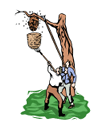
Bees and honey have featured extensively in culture and mythology throughout history. Cave drawings found in Spain dated around 6000 BC depict honey gatherers climbing trees to harvest honey from wild bees. These are thought to be some of the earliest illustrations of humans risking life and limb to obtain honey. Similar drawings have also been found in India, Africa, Asia and Australia.
While beekeeping dates back at least 4,000 years there are still many parts of the world where honey is gathered by climbing trees or rock faces. One thing we can be sure of is that humans have always had a sweet tooth and would go to great lengths to obtain honey.
Bees and honey have always been associated with fertility and had a special place in ancient Greece where the great mother Goddess Artemis was depicted as half woman and half bee.
The Mayans too were expert beekeepers and the Spaniards who came across them in the 16th century were surprised to find apiaries containing one to two thousand hives.
Honey and Wax
Honey was held in such high regard that it was presented as an offering to the Gods as ambrosia. The medicinal properties of honey were well known and it was used as an antiseptic and preservative. Honey was also included as an ingredient in creams, lotions and alcoholic drinks.
Wax and honey were used in the mummification process and jars containing honey have been found in Egyptian pyramids.
A story is told of a jar being opened and the finders tasting the contents and finding it still edible, until some hair was found in the honey!! On further investigation the jar was found to contain the fully preserved body of a child!!
Another important product harvested from the hive is wax. Candles made from beeswax were long lasting and had little smell and became essential in church services. Monks were able to meet the constant demand for candles by becoming beekeepers.
One of the most renowned Beekeeper monks was Brother Adam of Buckfast Abbey who developed a strain of bee valued the world over for its good temper and prolific honey production.
Skeps and Boles
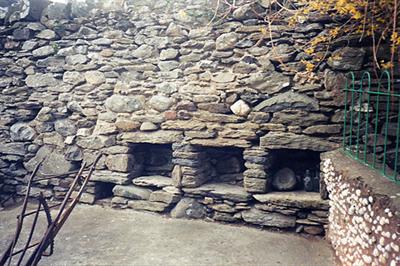
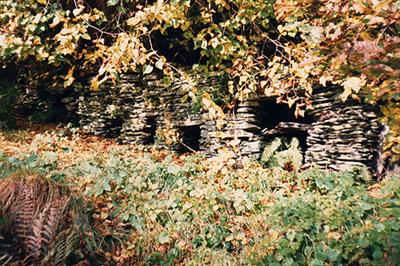
In medieval times bees were usually housed in hollowed-out logs or in skeps, and placed in alcoves in walls called bee boles. The word ‘skep’ is thought to originate from the old Norse word ‘skeppe’ which was used to mean a basket.
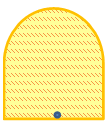

Harvesting the honey involved killing the colony by smoking with burning sulphur, and shaking the dead bees out of the skep. Boles can still be seen in old walls, though now may have a variety of uses. Some are used for garden ornaments, or potted plants, and the larger ones (bee shelves) have been used as wood stores. Generally the recesses in stone walls were 18-30 inches (46-76 cm) in height and 15-26 inches (38-66 cm) wide and 14-21 inches (36-53 cm) deep.
IBRA (International Bee Research Association) has records of bee boles and other beekeeping structures built in the past. Started by Dr Eva Crane in 1952, the Register now contains paper records for 1540 sites, including many in Wales.
Modern Beekeeping
There are many ‘greats’ in the world of beekeeping (each country can claim to have its own master beekeeper) who advanced the craft in some unique way. For example Rev. Charles Butler (1559-1647) described the functions of bees within the hive, how to manage swarms and honey collection in ‘The Feminine Monarchy’ (1623). Before this it was widely believed that the worker bees were all male. Thomas Wildman (1734-1781) developed the method of layering skeps, one on top of another. In this way the honey could be harvested without killing the bees. And Francois Huber (1750-1831) invented the ‘leaf’ hive making it possible to inspect frames, and identified the life cycle of bees.
However modern beekeeping, where bees are kept on moveable frames contained in wooden boxes, started about 150 years ago. Although many types of hive were designed in the 18th and 19th centuries, it is the American born Reverend L. Langstroth who is credited with the invention of an effective moveable frame hive, and over 70% of hives in use today are based on his design.
Bees in Wales
Conwy has a long association with beekeeping, dating back perhaps 1,000 years, and bee boles can be found in walls throughout the Conwy Valley, though there must be many more yet to be discovered.
In Conwy the holding of the annual Conwy Honey Fair is granted within Conwy Town’s Royal Charter and was granted by Edward I over 700 years ago. It is recorded that Edward bought a cask of honey at the fair in the 13th century.
The Honey Fair takes place every September on Conwy High Street, where beekeepers sell honey, honey soaps, beeswax candles and polish. Local beekeepers can sell about a tonne of honey by lunchtime!
In 2011 the National Trust undertook the restoration of a wall of bee boles at Dolmelynllyn Hall at Ganllwyd near Dolgellau. Prior to restoration the wall was officially recorded, 10 years ago, as having 38 boles, but as the work progressed a further 8 boles were found, making it the largest wall of bee boles in the UK.
In May 2012 the Merioneth Historical and Record Society and Merioneth Beekeepers Association began a joint project to identify bee boles in the Merioneth area. So far from 9 previously identified sites, they have now discovered a further 2 exceptional sites with bee shelves, and have more hitherto unknown sites to investigate.
All types of bee belong to the order of insects known as Hymenoptera. This order, comprising some 100,000 species, also includes wasps, ants and sawflies.
Most bee species are solitary, laying their eggs in tunnels which they excavate themselves. These bees provide a supply of food (honey and pollen) for the larvae, but there is no progressive feeding of the larvae by the adult bees.
Honeybees belong to the family of social bees, which include bumblebees and the tropical stingless bees of the genus Meliponinae.
Social bees nest in colonies headed by a single fertile female, the queen, which is generally the only egg-layer in the colony. Foraging for nectar, and other tasks such as feeding the queen and larvae, are carried out by a caste of females, the workers. Honey and pollen is stored and larvae are reared in cells made from wax secreted by the worker bees.
Honeybees comprise a single genus, Apis, from where the word for hives - “apiary” - is derived. They are characterised by the building of vertical combs of hexagonal cells using only the wax secreted by the worker bees. The cells are multi functional, being used for rearing the larvae and for the storage of honey and pollen. Young bees carry out progressive feeding of the larvae, with food produced by glands in the head of the bee from honey and pollen.
An important behavioural trait of honeybees is the communication of information about food sources and the recruitment of foragers by “dance language.” Communication of direction and distance of forage areas leads to efficient exploitation of food sources.
UK honeybees are of one species, Apis mellifera. Our native bee is the North European Apis mellifera mellifera sub-species, which is a dark bee.
Honeybees represent a highly organised and sophisticated society, with different bees having very specific roles during their lifetime – this is ‘division of labour at its best’ These include nurses, guards, cleaners, housekeepers, construction workers, royal attendants, undertakers, foragers, and so on.
Honeybees’ lifespan also varies, depending on the caste. The queen bee can live for several years. Worker bees live for 6 weeks during the busy summer, and for four-to-nine months during the winter months.
Although it may only seem active during summer, the honeybee hive is perennial. Bees survive the winter months by clustering for warmth, maintaining 93 degrees Fahrenheit in the centre of the cluster.
There are three castes of honeybee: Queen Bee, Worker Bee, and Drone Bee. Read more about them in The Hive.
The hive is created by and sustained through a strict social structure. This hierarchy is just one of the things that make bees so fascinating.
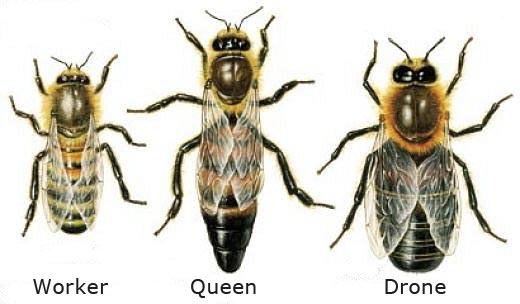
Queen Bee
- There is only one queen per hive, and she is the only bee with fully developed ovaries.
- She can live for 3-5 years, mates only once with several male (drone) bees, and will remain fertile for life.
- She lays up to 2,000 eggs per day.
- Fertilized eggs become female (worker bees) and unfertilized eggs become male (drone bees).
- When she dies or becomes unproductive, the other bees “make” a new queen by selecting a young larva and feeding it a diet of “royal jelly.”
Worker Bee
- All worker bees develop from fertilised eggs are female but are unable to reproduce.
- Worker bees live for 4-9 months during the winter season, but only 6 weeks during the busy summer months (they literally work themselves to death).
- Nearly all of the bees in a hive are worker bees – up to 30,000 bees in the winter, and more than 60,000 bees in the summer.
- The worker bees sequentially take on a series of specific chores during their lifetime: housekeeper; nursemaid; construction worker; grocer; undertaker; guard; and finally, after 21 days, they become a forager, collecting pollen and nectar.
- The worker bee has a barbed sting that results in her death after stinging, so she can only sting once.
Drone Bee
- Male bees develop from unfertilised eggs and so only contain the genetic material from their mother, the queen.
- These male bees are kept on standby during the summer for mating with a virgin queen.
- Because the drone has a barbed sex organ, death follows mating.
- There are up to 3,000 drones in a hive.
- The drone does not have a sting and because they are of no use in the winter they are expelled from the hive in the autumn.
The Welsh Beekeepers’ Association (Cymdeithas Gwenynwyr Cymru) has around 1,300 affiliated members, representing perhaps half of all beekeepers in Wales.
Most beekeepers are hobbyists, with only around 20 “bee farmers” with over 40 colonies, and no more than 10 “commercial” beekeepers. Their interests are represented by a number of beekeeping associations across Wales, and you can find out more about them from our useful links page.
Conwy Beekeepers Association was founded in 1978 and now has more than 150 members, including six of the founding members. Many of Conwy’s members have only one hive, while a few have more than 60! One family has kept bees continuously for 100 years.
Conwy Beekeepers Association also organises the Conwy Seed and Honey Fairs, which take place in March and September respectively each year. At these fairs the association helps to raise funds for the worldwide charity Bees for Development.
Across the UK, there are approximately 300 commercial bee farmers who depend on beekeeping for all or part of their income. There are also around 33,000 enthusiasts who pursue the craft for interest.
If you’d like to become one of them, learn how here
Bees face many threats, to the point where experts fear some species are threatened with extinction. Man’s activities feature highly, of course, but he’s not the only concern from a bee’s perspective.
Natural threats are posed mostly through mites and disease, especially the Varroa mite – originally from Central Asia. Although these mites can be kept under control by a persistent beekeeper, the negative effects on the honeybee population have been devastating.
Also, diseases such as “Foul Brood” and “Nosema” are harmful to bees. Good management and proper medication can usually address these problems for European Foul Brood and Nosema, although for American Foul Brood, all infected colonies in the UK are compulsorily destroyed. The first stage is to destroy the adult bees and brood combs by burning, then the hives and any appliances are sterilised by scorching with a blow lamp.”
More indirectly, man has a huge influence on bee survival. Urbanisation is perhaps one cause of declining bee numbers; with more and more urban development and the growth of cities, there is less and less foraging available to bees. However, intensive agriculture must take it’s share of the blame for the massive reductions in available forage for pollinators and for the deadly effects from widespread use of pesticides
Pesticides vary in their effects on bees. Contact pesticides are usually sprayed on plants and can kill bees when they crawl over sprayed surfaces of plants or other surfaces. Systemic pesticides, on the other hand, are usually incorporated into the soil or onto seeds and move up into the stem, leaves, nectar, and pollen of plants.
Neonicotinoid pesticides are at the centre of the debate on bee decline. This relatively new group of synthetic chemicals is related to nicotine and is highly toxic to insects. They are used as a coating for agricultural seeds. The chemicals spread throughout the plant and into the nectar and pollen that bees then eat. A recent study by the insect research charity Buglife and the Soil Association has claimed that the decline in the bee population has in part been caused by neonicotinoids.
Over the last century our wildflower meadows have been reduced by up to 97 per cent. The demand for food, technological advances in farming and the use of pesticides have all played their part, creating ‘green deserts’ – and the effect on our pollinators has been devastating.
They’re being pushed to the limits, literally, relying on hedgerows, trees and garden flowers for the nectar and pollen they need.
But it’s not all bad news and we can all make small changes that will help our beleaguered bees.
54% of UK towns and cities are greenspace - parks, allotments, sports pitches and so on. Domestic gardens account for another 18%, while woodland covers 12% of the UK. In fact, less than 2% of the UK is designated as ‘urban’ so there’s a lot of space left for plants, we just need to make sure there’s more of the right plants.
How you can help:
By planting bee-friendly plants in your garden you can make a real practical difference, and with a bit of thought you can provide an oasis for pollinators throughout the year.
You don’t have to become a beekeeper to help bees. Simply plant certain types of plants and shrubs in your garden or allotment and give them a helping hand as they forage for pollen and nectar essential to their survival. Whether you live in a town, city or the countryside, your garden can be a haven for busy bees!
Bee-friendly plants look great in the garden too! By planting the right type of plants and trees, you are providing a larder for honeybees and other pollinators, and habitats for wildlife. The pollination provides food for us and other wildlife, from birds to insects.
The British Beekeepers Association (BBKA) has produced a comprehensive list of bee-friendly plants you can grow in your garden or allotment. Click here to download it.
Research has shown that bees are more strongly attracted to gardens with a greater diversity of bee-friendly flowers. In addition, simple things like layout and light exposure can have a huge effect on the number and variety of bees it attracts. Use a wide variety of plants in your garden, and don’t be too tidy! Leave wild flowering plants in place, and ivy is a particularly important source of late season winter food for bees.
Remember, weeds are only weeds to us! Bees love dandelions and white clover. Can you leave them there just a little longer? You can remove them after the flowers are spent but before they go to seed.
Some bee species nest in the ground. Using mulch or weed-supressing sheets can stop them from nesting. Again, consider natural plant cover – and a little more weed tolerance! – rather than mulch and weed control fabrics.
Remember, only female honeybees have stings, and the European honeybee prevalent in the UK is not aggressive. Attract bees to your garden and still enjoy your summer barbecue!
What do bees do for us? ”
Pollination
Agriculture depends greatly on the honeybee for pollination. Honeybees account for 80% of all insect pollination, collecting approx 30 kilogram/66 lbs of pollen, per hive, per year. Without such pollination, we would see a significant decrease in the yield of fruits and vegetables.
Honey
There are many types, colours and flavours of honey. Bees make honey from the nectar they collect from flowering trees and plants, and they use it for food year-round. Honey has antibacterial qualities; eating local honey can fend off allergies.
Beeswax
Secreted from glands, beeswax is used by the honeybee to build honeycomb. Beeswax is used in drugs, cosmetics, artists’ materials, furniture polish, boot polish, and church candles.
Propolis
Collected by honeybees from trees, this sticky resin is mixed with wax to make a glue the bees use to seal cracks and repair their hive. Propolis is used as a health aid, and as the basis for fine wood varnishes.
Royal Jelly
The powerful, milky substance that turns an ordinary bee into a Queen Bee is made from digested pollen and honey or nectar, and mixed with a chemical secreted from a gland in a nursing bee’s head. Loaded with B vitamins, it is used by some as a dietary supplement and fertility stimulant, and commands premium prices (rivalling imported caviar!).
Mead
Mead is one of the oldest known drinks and was very popular up to the 18th century. It is a type of wine, often sweet, made from honey, water and yeast, typically containing 12-14% alcohol.
The growth of urban development has had a dramatic effect on bee numbers, reducing areas where they can forage for pollen and nectar. Now you can help bring the honeybee back to our towns and cities.
You don’t need to be a landowner or live in the country to keep bees. Urban gardens or roofs make ideal locations for hives – The Waldorf Astoria in New York City has hives on its roof! Or “rent” a hive through your local beekeepers association, just as you would an allotment.
If you don’t want to keep bees, you can help them by planting bee-friendly gardens. Town gardens, roof gardens, allotments, local parks and open spaces all attract bees. Hanging baskets not only brighten our streets and homes, they can attract pollinating insects too. Many local authorities are now adopting bee-friendly landscaping in parks and streets.
Try one of our Beekeeping Courses.